
When presented with the options for our early technology presentations, the typewriter immediately stood out to me. The typewriter is one of the pieces of technology that still exist in the memories of our living elders. Still, it has no relevance in my generation, so I wanted to dive deeper into why it was so groundbreaking in the early days of technology. 
The typewriter's developmental phase was invented by John Galloway, a grocery clerk from Paisley, Scotland, in 1864. The idea behind the typewriter was to imitate that of a keyboard on a piano to become more efficient in writing letters. Galloway immigrated from Scotland to America in the early 1840’s; however, it is proven that he invented the typewriter, as evidenced by a letter sent home in 1868 to his great, great niece. The letter explained that he came up with the idea of using the piano keyboard as a model for his invention.
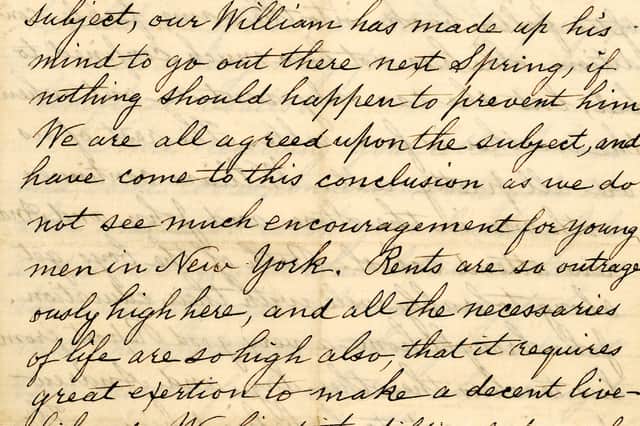
A part of the letter states: “When I was young in comparison to what I now am, I took up the idea that some kind of machine could be made with keys, similar to those of a piano, to print letters, instead of writing them with a pen,” Galloway wrote home to his niece. It would surely be as easy and as speedy to operate upon keys with the fingers, as to write with a pen; the trouble of learning would be less, and the composition would be more easily read than when done up in a rugged scrawl.”
After immigrating to America, Galloway invented a new version of his typewriter that typed in ink rather than embossing, as in his prior model. As Galloway was tweaking his creation, Sholes was patenting what we now know as the modern typewriter.
However, the typewriter idea failed to stick in Galloway's hands. The first commercially patented typewriter was by Christopher Sholes, Carlos Glidden, and Samuel Soule. The patient that Sholes had was sold to E. Remington and Sons in 1873, a company known for manufacturing sewing machines.

The model, after Remington and Sons, was then known as the Remington Typewriter. This typewriter adopted an interesting layout that is still used today: the QWERTY layout. What is the QWERTY layout? This layout shows the letters Q, U, E, R, T, and Y as the first six letters in the top-left corner of the keyboard. The purpose of putting these letters in the top left corner was to prevent the mechanical arms of the keyboard from sticking together. Because this method worked well, the typewriter was adopted by corporate offices worldwide.

The impact that the typewriter had on the world was truly incredible, especially for women. Before the typewriter came out, women did not have jobs in corporate America. However, since typing was new and not a male-dominated field, it opened up opportunities for women, and that is how they entered the workforce.

Lastly, the typewriter helped with the credibility of letters. Since the type was legible, it helped avoid second-guessing the handwritten penmanship that preceded the typewriter.