Monday, March 23, 2026

Thank You For Smoking


The movie Thank You for Smoking starred Nick Naylor, who played the role of the chief lobbyist and spokesperson for the Academy of Tobacco Studies. Throughout the movie, Naylor defended the use of cigarettes in court, saying that smoking cigarettes was not harmful to the human body. Naylor then testified against Senator Finistirre of Vermont, whose goal was to put gruesome images on cigarette packs to turn off customers from purchasing cigarettes and failed.


I don’t believe I could do Nick Naylor’s job, regardless of the amount of money they offered me at the time of signing. As someone who has lost family due to cigarette smoking, I don't think that it would be a good fit for me. To me, it is like asking a vegan to work at Tyson. If they don't eat chicken due to being a vegan, then why would they compromise their values for a job? Sure, the money is nice, but ultimately, when you sign for a job, the goal is longevity and you can't fulfill that promise to yourself if the pressure of compromised morals weighs you down every time you walk in the door. 

I think it is great that the former student was able to secure an internship and work full-time at the same company afterwards. However, for me, it does not matter what division of RJ Reynolds I would be working for, as in my eyes, nicotine is nicotine. I can understand why it is appealing to others, as they are not inhaling cigarette smoke and coming home smelling like it either. This is what is great about the world we live in: everyone can do the things that make them happy thanks to freedom of speech and expression. Just because I do not agree with something does not mean that someone else is unable to work in that industry or partake in the product. This is something that I believe Senator Finistirre of Vermont needed a better understanding of. He tried so hard to force people not to smoke due to it being unhealthy, going as far as putting disturbing photos of the cartons. As much as the pictures on the cartons could have been passed as a law, the senator needed to understand that if people truly wanted to smoke, they were going to do so regardless of a package.

Overall, I thoroughly enjoyed the movie because it helped me better understand different viewpoints and reinforced the idea that you should stand up for what you believe in. Nick Naylor is a perfect example of this, because for a long time he was an activist for one of the largest cigarette corporations in the country, until getting in trouble with his boss for what was said in a newspaper article that Heather Holloway, the reporter, wrote, which included information that was said behind closed doors and supposedly off the record. I absolutely do not believe that what Heather did was right and should go against all moral and ethical standards, however,  after getting in trouble with the cigarette company, Naylor started to think about his son and decided that he did not want to work for the Academy of Tobacco Studies anymore, going as far as turning down the same job that he had before with a higher salary. I commend Naylor for doing so because he stood up for his ethical beliefs and for his family.


Friday, March 6, 2026

The History of the Typewriter

When presented with the options for our early technology presentations, the typewriter immediately stood out to me. The typewriter is one of the pieces of technology that still exist in the memories of our living elders. Still, it has no relevance in my generation, so I wanted to dive deeper into why it was so groundbreaking in the early days of technology. 
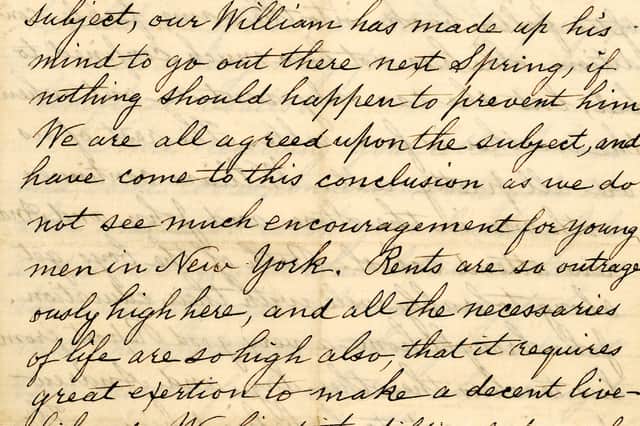
The typewriter's developmental phase was invented by John Galloway, a grocery clerk from Paisley, Scotland, in 1864. The idea behind the typewriter was to imitate that of a keyboard on a piano to become more efficient in writing letters. Galloway immigrated from Scotland to America in the early 1840’s; however, it is proven that he invented the typewriter, as evidenced by a letter sent home in 1868 to his great, great niece. The letter explained that he came up with the idea of using the piano keyboard as a model for his invention. 
A part of the letter states: “When I was young in comparison to what I now am, I took up the idea that some kind of machine could be made with keys, similar to those of a piano, to print letters, instead of writing them with a pen,” Galloway wrote home to his niece. It would surely be as easy and as speedy to operate upon keys with the fingers, as to write with a pen; the trouble of learning would be less, and the composition would be more easily read than when done up in a rugged scrawl.”
The letter written in 1868 which details Galloway's invention of an early writing machine, which he likened to a piano which printed letters.
After immigrating to America, Galloway invented a new version of his typewriter that typed in ink rather than embossing, as in his prior model. As Galloway was tweaking his creation, Sholes was patenting what we now know as the modern typewriter.
However, the typewriter idea failed to stick in Galloway's hands. The first commercially patented typewriter was by Christopher Sholes, Carlos Glidden, and Samuel Soule. The patient that Sholes had was sold to E. Remington and Sons in 1873, a company known for manufacturing sewing machines. 

half length photo of a woman seated while a typewriter sits on the table
The model, after Remington and Sons, was then known as the Remington Typewriter. This typewriter adopted an interesting layout that is still used today: the QWERTY layout. What is the QWERTY layout? This layout shows the letters Q, U, E, R, T, and Y as the first six letters in the top-left corner of the keyboard. The purpose of putting these letters in the top left corner was to prevent the mechanical arms of the keyboard from sticking together. Because this method worked well, the typewriter was adopted by corporate offices worldwide.


The impact that the typewriter had on the world was truly incredible, especially for women. Before the typewriter came out, women did not have jobs in corporate America. However, since typing was new and not a male-dominated field, it opened up opportunities for women, and that is how they entered the workforce.
Lastly, the typewriter helped with the credibility of letters. Since the type was legible, it helped avoid second-guessing the handwritten penmanship that preceded the typewriter.